World Crude Oil Production and the Oil Price

In April 2012 I published this post about World Crude Oil Production and the Oil Price (in Norwegian) which was an attempt to describe the developments in the sources of crude oils (including condensates), tranches of total life cycle costs (that is [CAPEX {inclusive returns} + OPEX] per barrel  of oil) and something about the drivers for the formation of the oil price.

Rereading the post and as time passed, I learnt more and therefore thought it appropriate to revisit and update the post as it in my opinion contains some topics from what I have observed, learned and discussed that have been given poor attention and appears poorly understood.

I will continue to pound the message that oil prices are also subject to the reality of;

  • “Demand is what the consumers can pay for!”

Figure 1: The chart above shows the developments in the oil price [Brent spot] and the time of central banks’ announcements/deployments of available tools to support the global financial markets which the economy heavily relies upon. The financial system is virtual and thus highly responsive. The chart suggests causation between FED policies and movements to the oil price.
Figure 1: The chart above shows the developments in the oil price [Brent spot] and the time of central banks’ announcements/deployments of available tools to support the global financial markets which the economy heavily relies upon. The financial system is virtual and thus highly responsive.
The chart suggests causation between FED policies and movements to the oil price.
The four big central banks, BoE, BoJ, ECB and the Fed expanded their balance sheets with $6 – 7 Trillion following the Lehman collapse in the fall of 2008. These liquidity injections are about to end.

Since 2008 most of the advanced economies’ credit expansions originated from the central banks, the lenders of last resort. Central banks are collateral constrained.

The consensus about the oil price collapse during the recent weeks is attributed to waning global demand and growth in  supplies.

All eyes are now on OPEC.

  • Any forecasts of oil (and gas) demand/supplies and oil price trajectories are NOT very helpful if they do not incorporate forecasts for changes to total global credit/debt, interest rates and developments to consumers’/societies’ affordability.

For more than a decade, I have carefully studied the forecasts (and been involved in numerous fruitful [private] discussions) from authoritative sources like the Energy Information Administration (EIA) and the International Energy Agency (IEA) including the annual outlooks from several of the major oil companies and I did NOT find that any of these takes into consideration changes to global credit/debt [growth/deleveraging], levels of total global credit/debt and interest rates.

Continue reading “World Crude Oil Production and the Oil Price”
The Powers of Fossil Fuels

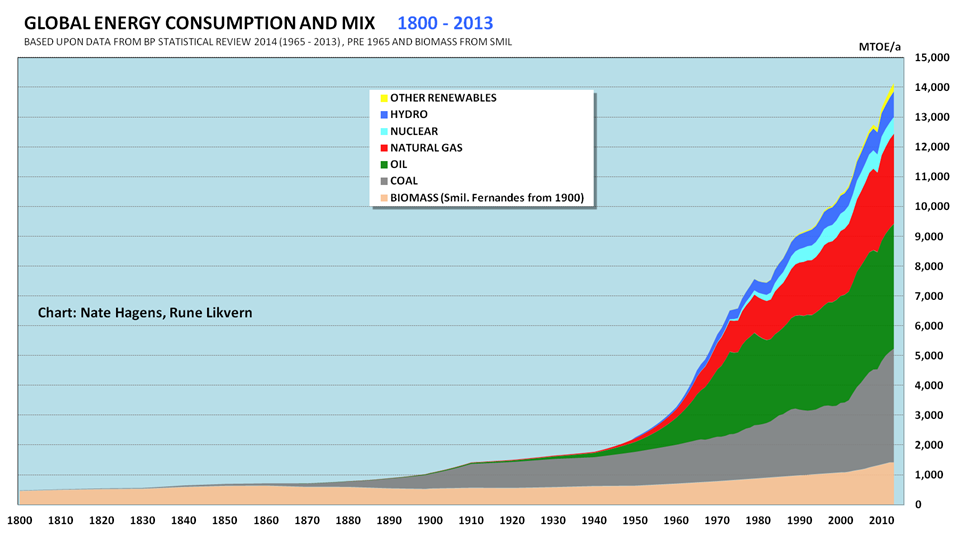
In this post I present a brief perspective spanning two centuries of the history of energy and mainly fossil fuels (FFs) consumption. Then a brief look at the recent years growth in solar and wind (renewables) and how their growth measures up against FFs since 1990.

Figure 1: The chart above shows the developments in the world’s total energy consumption split on sources as from 1800 and into 2013. The chart has been developed in a joint between Dr Nate Hagens and me.
Figure 1: The chart above shows the developments in the world’s total energy consumption split on sources as from 1800 and into 2013. The chart has been developed in a joint effort between Dr Nate Hagens and me.

In the early 1800s biomass (primarily wood) were humans’ primary source for exogenous energy. Coal became increasingly introduced into the energy mixture after the successful development and deployment of the steam engine which gave birth to the Industrial Revolution. Coal is a nonrenewable, abundant and a denser energy source than wood. The growing use of biomass had led to deforestation in those areas serving energy intensive industries like mining and metals. The steam engine and its use of abundant coal as an energy source made it possible to rapidly expand the industrial production, create economic growth, thus the Industrial Revolution was in reality a revolution made possible by fossil fuels. With the most recent discoveries and introduction of fossil oil and natural gas there appeared to be several abundant sources of volumetric dense energy that could entertain exponential and illusive economic growth. Fossil fuels represent natures’ legacy stock of dense energy (ancient sunlight) that during some decades has been subject to an accelerated depletion. Several reports in the media may now leave the impression that we are at the threshold for a smooth transition from FFs to renewables (solar and wind). However, how does this measure up against hard data? Continue reading “The Powers of Fossil Fuels”

Status of Norwegian Natural Gas and a Forecast towards 2025

In this post I present actual Norwegian natural gas production, status on reserves, the development in discoveries and what this results for my expectations for the future delivery potential for Norwegian natural gas.

Included is also a brief look at actual and forecast development for EU’s (+Norway) consumption and production of natural gas.

Norway is not a formal member of the European Union (EU).

This post is an update on my post back in March 2013 (in Norwegian).

Norway, after Russia, has been and is the EU’s second biggest supplier of natural gas. In Europe the outlook for natural gas supplies is followed with heightened interests following the recent developments in Ukraine and its ability to continue to afford Russian natural gas. A big portion of the  natural gas consumed by EU transits from Russia through Ukraine.

The potential for any interruptions to EU’s natural gas supplies has made EU consult other suppliers requesting these to have a look at their potentials to increase deliveries to offset any shortfalls to natural gas deliveries from Russia.

Fig 1 Norway actual as of 2013 and forecast natural gas production to 2025
Figure 1: The chart above shows development in natural gas exports from production installations on the Norwegian Continental Shelf (NCS) as reported by the Norwegian Petroleum Directorate (NPD) from 1996 to 2013 and with my forecast for delivery potential towards 2025. The chart also shows the Norwegian Ministry of Petroleum and Energy (MPE) forecasts; green line upper projection, orange line lower projection. The black dotted line is the forecast from the International Energy Agency’s World Energy Outlook 2012 (IEA WEO 2012). Numbers are believed to be gross exports from the production installations and thus not adjusted for “shrinkage” from Natural Gas Liquids (NGL) extraction, primarily at Kollsnes and Kårstø. The NGL extraction reduces total sales gas volumes with around 4% relative to what is exported from the production installations. Numbers in Giga cubic meters (Gcm = Bcm)

My forecast (developed in the spring of 2014) and the forecast from the Norwegian Ministry of Petroleum and Energy (MPE) shows basically the same trends, but differs about the timing for the start of  the decline and how steep it will become. My forecast results in some kind of plateau towards the end of this decade followed by a steep decline, refer also figure 4.

I now expect the Norwegian delivery potential for natural gas to decline by 40 – 50% by 2025.

Continue reading “Status of Norwegian Natural Gas and a Forecast towards 2025”